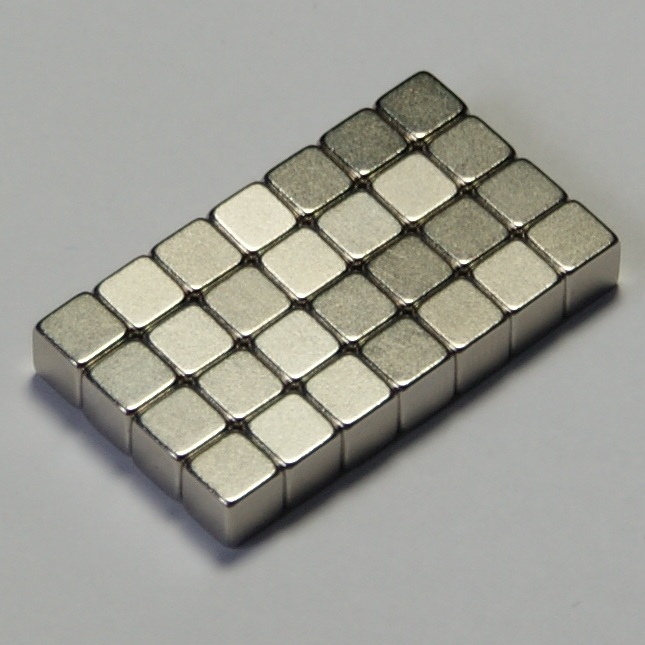
Neodymium magnets — also called NdFeB magnets — are the strongest permanent magnets in the world. A small one can lift hundreds of times its own weight. That is why they are everywhere: in motors, speakers, headphones, wind turbines, MRI machines and electric cars.
What does "NdFeB" mean?
The name comes from the three main elements: Ndeodymium, Fe (iron) and B (boron). Together they form a compound that stores magnetic energy far better than older magnet materials like ferrite or AlNiCo.
Because neodymium belongs to the rare-earth family, NdFeB magnets are often called rare-earth magnets.
How strong are they?
Compared with other permanent magnets:
| Material | Relative strength* | Typical use |
|---|---|---|
| NdFeB | Strongest | Motors, EVs, speakers, sensors |
| SmCo (samarium-cobalt) | ~½ of NdFeB | High-temperature, aerospace |
| Ferrite | ~1/10 of NdFeB | Cheap everyday magnets, fridge magnets |
| AlNiCo | ~1/10 of NdFeB | High-temperature sensors |
*Approximate energy product comparison.
Three main types
- Sintered NdFeB — the most common type. Powder is pressed in a magnetic field and sintered into a hard block. Highest performance.
- Bonded NdFeB — magnetic powder mixed with plastic, then molded. Weaker but can be made in complex shapes.
- Hot-pressed NdFeB — compressed at high temperature. Used for special small motors.
Where are they used?
The biggest applications are electric motors (cars, home appliances, tools), electronics (phone speakers, headphones, haptic motors), wind turbines, MRI machines, and countless sensors and holding devices.
Two things to remember
- They are brittle — they can chip or crack if knocked together.
- They lose strength when hot, and they can corrode, so most are coated with nickel, zinc or epoxy.
Read on: the four key magnetic parameters → · materials compared →