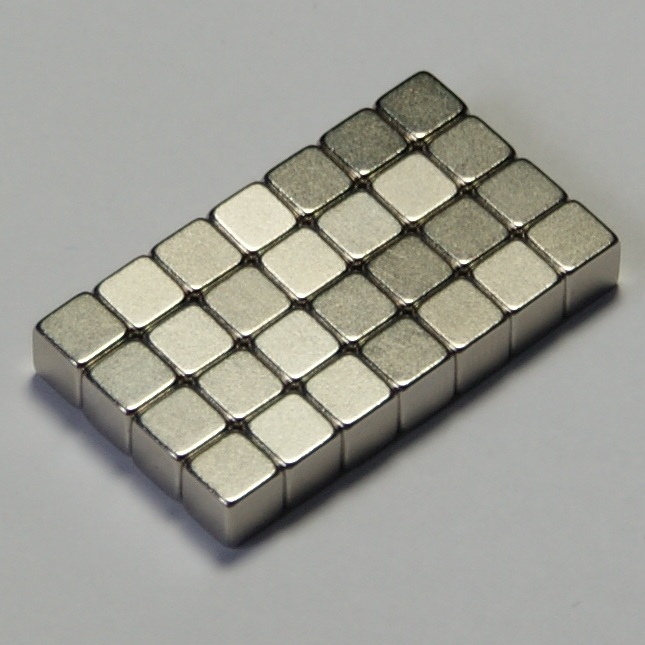
Bare neodymium magnets do not survive in the real world. The material is chemically active and full of tiny pores, so it rusts quickly in moist air — and faster still in humid, salty conditions. In one lab test, a bare 1 cm³ magnet was fully corroded after about 51 days in a hot oven. Coatings are not a luxury; they are what turn a magnet into a usable product.
Why coating matters
Corrosion is not just ugly. It eats the magnetic material itself, so the magnet gets weaker and weaker until it is useless. A good coating does three jobs: it blocks moisture and salt, it stops loose particles shedding off the surface, and it protects the brittle magnet from chipping during assembly.
The common coatings
| Coating | Look & feel | Strength | Best for |
|---|---|---|---|
| Nickel (NiCuNi) | Bright, shiny, hard | Great all-round protection | Visible magnets — the standard choice |
| Zinc | Matte grey | Decent indoors, weak against salt | Cheap, hidden magnets |
| Epoxy | Black or colored resin | Excellent against salt, acid, moisture | Tough environments, motors, automotive |
| Phosphating / passivation | Thin grey film | Light, short-term protection | Storage and pre-treatment |
| Parylene | Invisible polymer film | Excellent; reaches into tiny holes | Small rings and tubes |
Choosing one
There is no universal winner. Nickel is the balanced default for visible parts. Zinc saves money when nobody sees the magnet. Epoxy is the pick for harsh, humid or salty environments. As a rough guide, price runs zinc < nickel < epoxy.
Whatever you choose, put the coating spec — type, thickness and salt-spray hours — on your drawing. And remember: a coating only protects if it is applied well. Cheap plating with poor pre-treatment will blister and peel long before the advertised test hours are up.
Read on: why magnets rust → · grades explained →