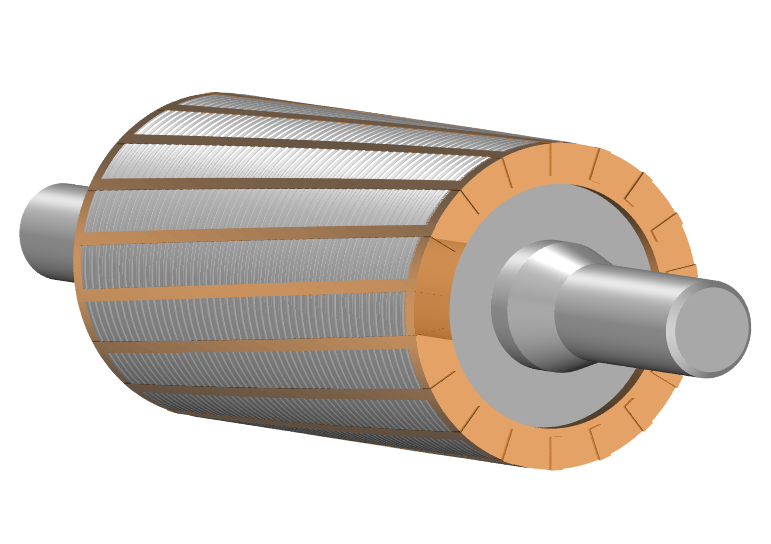
Imagine a ring magnet sliced like a pizza, with alternating north and south slices all around. That is a multipole ring: a single piece of magnet with many magnetic poles around its circumference. It replaces the old approach of gluing several arc-shaped magnets around a motor rotor — one part instead of many.
Where multipole rings are used
- Motors — servo and small DC motors, where many poles give smooth rotation.
- Rotary encoders — the ring's alternating poles are read by a sensor to measure position and speed.
- Magnetic couplings and bearings — contact-free torque and support.
How they are made
First, the ring is radially oriented: during pressing, the crystals are aligned so every point around the circumference is magnetically aimed outward. Then a magnetizing fixture — a coil with the exact pole pattern — imprints alternating N/S poles around the ring. The pole count is simply a choice of fixture.
Why one piece wins
- Fewer parts, faster assembly — no segments to glue, no tolerance stacking.
- Smoother field, quieter motors — no jumps between glued segments, so torque is smoother and noise drops.
- Better precision — encoder signals stay clean and evenly spaced.
Materials and care
Bonded NdFeB rings are the cheapest and most common; sintered NdFeB gives the strongest performance but is brittle and costly; hot-pressed rings cover small, thin high-end parts. Sintered and hot-pressed rings can crack under a strong magnetizing pulse or rough assembly — handle them like glass.
Read on: orientation and magnetization → · magnets in motors →