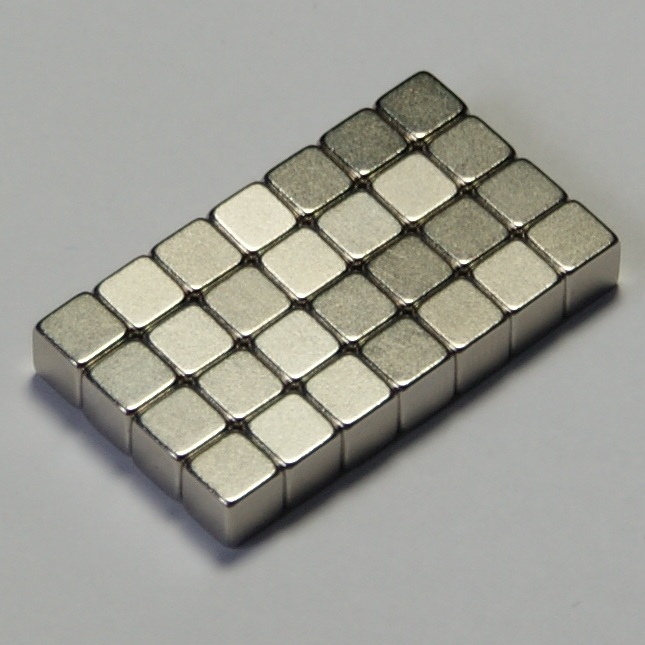
A neodymium magnet's price tag is set long before the magnet factory. Most of the cost is the raw rare-earth materials inside it — expensive for reasons that have nothing to do with scarcity in the ground.
Rare earths aren't rare
The name is a historical accident. Cerium is about as common in the Earth's crust as copper, and neodymium is more abundant than lead. The catch: the 17 rare-earth elements are chemically almost identical — they always come out of the ground mixed together, and nature never separates them.
Separation is the hard part
Pulling them apart takes hundreds of stages of chemical extraction, each consuming acids, solvents and energy. It is the single most expensive step in the chain, and it happens before any magnet exists: ore, then separation, then metal, then the magnet factory.
Environment and geography add risk
Rare-earth mining and refining are messy industries with real environmental costs, and stricter enforcement has repeatedly taken supply offline — spiking prices. The supply chain is also concentrated: China handles the overwhelming majority of the world's refining and separation, so quotas, export rules and geopolitics move prices.
Mines produce everything, magnets want a little
A mine produces all 17 rare earths together, but magnets mainly want two — neodymium and praseodymium — and the heavy rare earths for heat-resistant grades, dysprosium and terbium, are far scarcer. That is why terbium costs about nine times as much as PrNd.
What the numbers look like
Mid-2026 reference prices: PrNd oxide around CNY 890/kg, dysprosium-iron alloy around CNY 1,360/kg, and terbium metal around CNY 8,300/kg (see our Market Trends page). Prices also swing wildly — PrNd has quadrupled and halved within a decade. That volatility is why magnet quotes change and high-temperature grades cost several times more than standard ones.
Read on: live rare-earth price charts → · how grain boundary diffusion saves Dy and Tb →