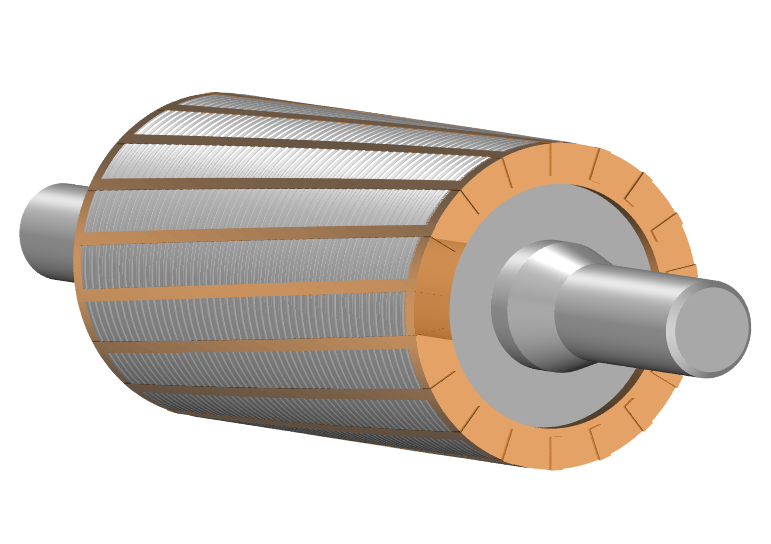
Sometimes you need to transmit rotation from one shaft to another — but the two shafts must not touch. That is exactly what a magnetic coupling does: it passes torque across an air gap using nothing but magnetic pull.
How it works
Two rings of magnets face each other across a small gap. One ring is driven by the motor; the other drives the load. Each ring carries alternating north and south poles, so opposite poles attract across the gap and lock the two halves together. When one ring turns, it drags the other along — no gears, no contact, no wear. The thinner the wall between the rings, the more torque the coupling can carry, so the whole design is about getting the magnets as close together as possible.
The big win: no leaks
In a pump or mixer, the shaft usually has to pass through a wall, and the rotating seal around it wears out and leaks. A magnetic coupling replaces the shaft with magnetic force, so the wall needs only a static seal — or none at all. That is why magnetic couplings dominate pumps handling corrosive, toxic or sterile liquids: zero leakage by design.
Where magnetic couplings are used
- Chemical and pharmaceutical pumps — no seal means no drips.
- Food and beverage mixers — nothing can contaminate the product.
- Agitators and stirrers — torque through a closed vessel.
- Vacuum and pressure systems — the wall stays sealed.
One caution: if a synchronous coupling is overloaded, the poles can slip and the magnets heat up fast — enough to permanently weaken them. Within its rated torque, though, it transmits speed exactly, forever.
Read on: magnetic separators in industry → · the NdFeB magnets inside →