Every photo, song and document on your devices started life as nothing more than a pattern of tiny magnetic regions. That is magnetic recording — storing data as magnetization.
Bits as tiny magnets
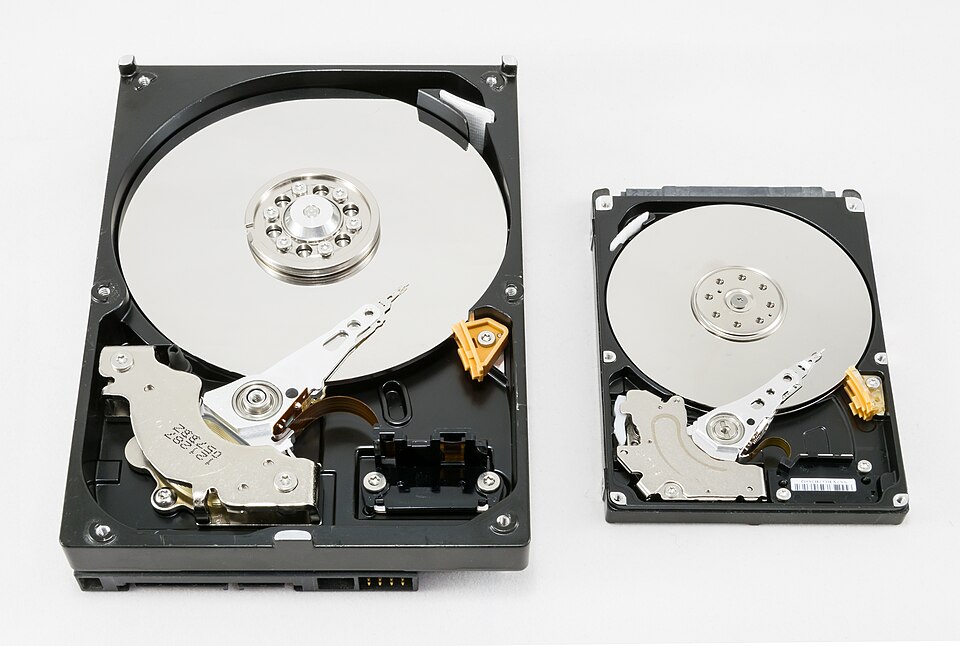
A hard drive stores data on spinning platters coated with a thin magnetic layer. The surface is divided into microscopic regions, each one magnetized in one of two directions — north up or north down. Those two states are the 1s and 0s of computer data. A read/write head floats above the platter: writing flips the regions into the right pattern, reading detects the pattern and turns it back into bits.
A magnetic family tree
Magnetic storage is older than you might think. Audio tape and video tape record sound and pictures as magnetization along a moving ribbon. Floppy disks did the same job for early computers. All of them rely on one principle: a material that keeps its magnetization until you deliberately change it.
Magnets inside the drive
Hard drives also lean on permanent magnets in a second way. The voice coil motor that swings the read/write arm uses a strong magnet, and the spindle motor that spins the platters is a brushless motor built around permanent magnets. Without them, drives would be slower, heavier and far less precise.
The SSD takeover
Solid-state drives have replaced magnetic storage in most new computers. They are faster and have no moving parts, so nothing wears out. But magnetic recording lives on in data centers, where cheap, dense hard drives still store the world's archives.
Practical tip: keep stray magnets away from drives and tapes — a strong field can flip the stored bits and quietly erase data.
Read on: a short history of magnets → · magnetic moment →