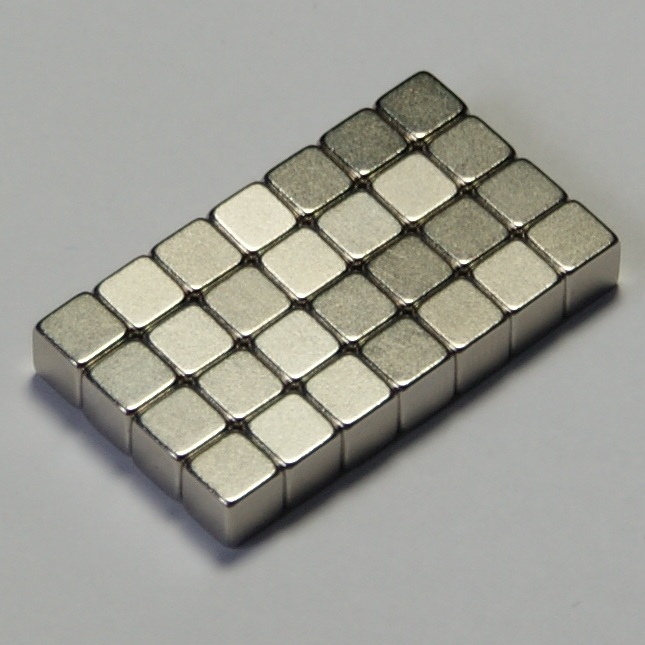
When engineers pick a magnet, they usually look at the magnetic numbers — strength, coercivity, temperature rating. But a magnet also has physical properties: how heavy it is, how it handles heat, whether it conducts electricity. These quieter numbers decide how the magnet behaves in a motor. Here are the three that matter most.
Density — how heavy it is
Sintered NdFeB has a density of about 7.5–7.6 g/cm³ — roughly steel's weight, and heavier than ferrite.
Why it matters: density sets the weight of your assembly, a real concern for rotors and handheld devices. It is also a quality hint: a lighter-than-expected magnet may be porous, weakening both magnetism and strength.
Thermal expansion — it grows and shrinks unevenly
Most materials expand evenly when heated. NdFeB does not: it expands along one direction and slightly shrinks in the other two.
Why it matters: this uneven growth is why radial rings are hard to make — the directions pull against each other and cause cracks. In motors, a magnet and its steel frame expand at different rates, so fit must be designed for the hottest condition, not room temperature.
Electrical resistivity — how well it conducts
NdFeB is a metal alloy, so it conducts electricity well — its resistivity is low, like most engineering metals.
Why it matters: inside a motor or generator, the changing field creates swirling currents in the magnet (eddy currents), and those currents become heat. The better the magnet conducts, the hotter it gets — and heat is the main enemy of magnet strength. See temperature behaviour for the magnetic side.
The short version
| Property | One sentence |
|---|---|
| Density ≈ 7.5–7.6 g/cm³ | As heavy as steel; low density hints at porosity |
| Thermal expansion | Grows one way, shrinks the other — rings crack, fits shift |
| Resistivity (low) | Conducts electricity, so eddy currents heat it in machines |
Read on: mechanical properties → · simulating magnet fields →