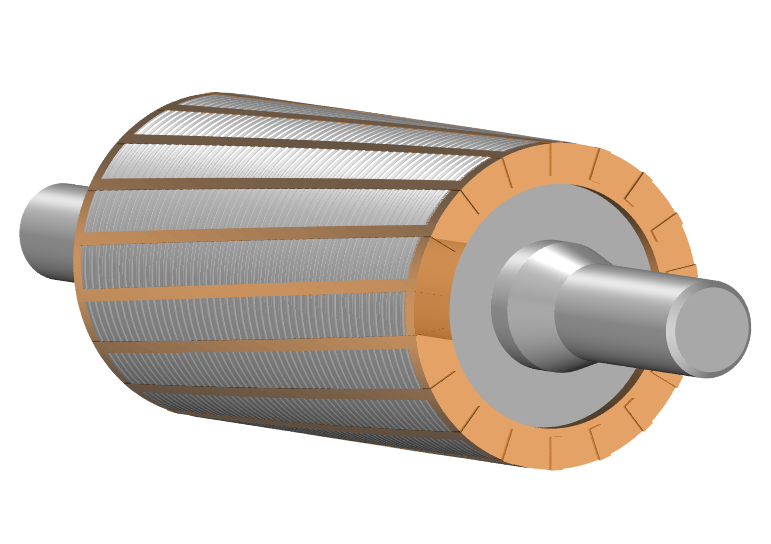
Inside an electric toothbrush, a drone gimbal or a surgical tool, there is often a tiny motor that starts almost instantly and hums almost silently. That is the hollow-cup motor — a small DC motor with a clever design trick: its coil has no iron core.
What “no iron” does
In a normal motor, the coil is wound around an iron core. In a hollow-cup motor, the wire is wound into a self-supporting cup shape that spins in the gap around a ring magnet (or the magnet spins around a cup-shaped coil). Removing the iron changes everything:
- Instant response. Nothing heavy to spin up, so the motor starts, stops and reverses almost instantly — no lag.
- Smooth motion. Iron cores “cog” against the magnets in steps. Without iron there is nothing to cog against, so rotation is silky — great for precision optics and camera autofocus.
- Quiet and efficient. Less friction and wasted energy, which roughly doubles battery life in portable devices.
- Light and small. Ideal where weight and space are tight, like drones and robots.
The magnet inside
The hollow-cup motor is a permanent-magnet machine, and the magnet sets its performance ceiling. The standard choice is sintered NdFeB in the form of a ring magnet, typically grades N40 or N45. With the same motor and the same current, a stronger magnet simply means a faster, more powerful motor — so the magnet grade is one of the first things engineers check when a motor underperforms.
Where they shine
Drones, robots, medical devices, optical drives, electric toothbrushes, face brushes — anywhere you need fast response, quiet running, low weight and good battery life in a tiny package.
Read on: magnets in electric motors → · magnets in 3C electronics →