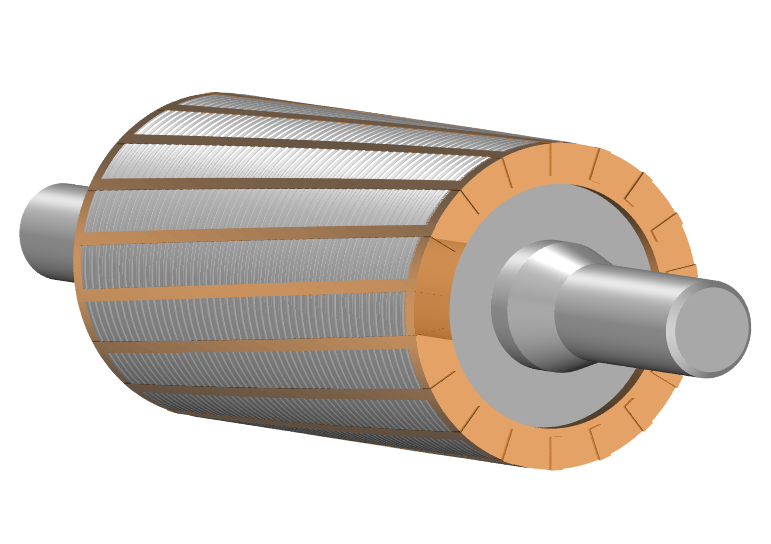
A reluctance motor makes torque without any magnets at all. Its rotor is simply shaped steel, and it works because magnetism — like water — takes the path of least resistance.
The basic idea
"Reluctance" is the magnetic version of resistance: how hard it is for a magnetic field to flow through a material. Steel conducts magnetism easily; air does not. In a reluctance motor, the rotor is shaped so that magnetism flows easily in some directions and not others. The stator field pulls the rotor around, always trying to line up with the easy direction. The rotor never quite catches up — that constant pull is the torque.
Two main families
- Synchronous reluctance motors — the rotor has layers of steel and air pockets; runs quietly, used in pumps, fans and industrial drives.
- Switched reluctance motors — a toothed rotor with coils pulsed in sequence; rugged and simple, used in vacuums, appliances and some EV prototypes.
Why choose a magnet-free motor
No magnets means no magnet material cost, no rare-earth supply questions, and no demagnetization risk at high temperature. The rotor is just steel, so it is cheap, tough and easy to build. The trade-off: efficiency is a little lower, and the drive electronics are more complex than for a magnet-based design of similar size.
Where you will meet them
Reluctance motors are increasingly common in appliances, HVAC fans and industrial pumps, where low cost, ruggedness and respectable efficiency win. For buyers, they are a useful benchmark: compare a reluctance motor against a permanent-magnet motor with the same frame size, and you will see exactly what the magnets buy you.
Read on: magnets in motors → · magnetic circuits →