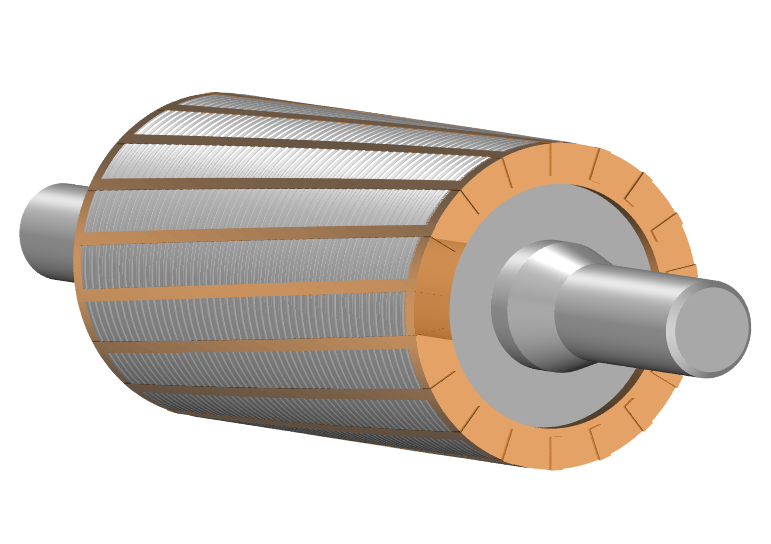
A stepper motor is a motor that moves in precise, fixed angular steps instead of spinning freely. Command a set number of steps and it turns exactly that far — no position sensor required.
How stepping works
A stepper motor has many small magnetic teeth around the rotor and coils arranged around the stator. The drive energizes the coils in sequence, and the rotor snaps to the position where its teeth line up with the energized field. Each switch of the coils moves the rotor by one step — typically 1.8 degrees, or 200 steps per revolution.
Two common types
- Permanent-magnet steppers — the rotor is a magnetized cylinder; simple and cheap, used in cameras and instrument dials.
- Hybrid steppers — combine a toothed magnet rotor with an iron core; finer steps and more torque, the standard for 3D printers and CNC.
Why open-loop is enough
Because each step is a fixed angle, the controller always knows where the rotor is — as long as it does not lose a step. That gives open-loop positioning: precise motion with no feedback sensor, which keeps cost and wiring simple.
Where you will find them
3D printers are the classic example — every axis and the extruder run on steppers. You also meet them in CNC machines, camera lenses, telescopes, vending machines and medical pumps.
The permanent magnets in the rotor supply the holding field that locks it into position; stronger magnets mean stronger holding torque, so modern hybrid steppers often use NdFeB. If a machine loses steps, the position is lost — which is why some designs add magnetic encoders to close the loop.
Read on: magnets in motors → · magnetic encoders →